Thursday, 4 February 2016

Corporate Social Responsibility (CSR)

The term ‘Corporate Social Responsibility (CSR)’, in its most rudimentary sense, implies the responsibilities
 that business houses owe to the society for ensuring public welfare. The term was coined with the primary goal of controlling corporate aggrandizement by ensuring that the fruits of progress are distributed amongst all sections of society- especially historically marginalized and deprived sections.

The Companies Act, 2013


The new Companies Act, 2013, marks a paradigm shift in the legislature’s conception of Corporate Social Responsibility (CSR).
More specifically, it does not view Corporate Social Responsibility merely as a moral obligation that the corporate world owes to the society; instead, it imposes a mandatory obligation on all companies that meet the required criteria to play their part for alleviating the problems that continue to cripple our country.
In a nation like India, where there exists a wide chasm between large business houses and millions of people who continue to live in grinding poverty, it is hoped that the new CSR provisions will pave the way for a more just and equitable social order and will ensure wider acceptance of the principle that the business of business is not merely business.

Eligibility criteria

Thursday, 28 January 2016

Changes you must know for registration of company’s name under new Rules

The Govt. has notified the Companies (Incorporation) Amendment Rules, 2016
 (‘Amended Incorporation Rules’). Now the process of reservation of name of
companies has been simplified. Following changes have been made for ease
of doing business in India:
1) Name of company need not to be in consonance with principal object:
Under extant norms, the company’s name was necessarily required to be in
consonance with principal object, if such name resembled any object of
company. Now as per the amended Rules the name of company will not be
considered undesirable even if it is not in consonance with the principal objects

Clubbing of income under income tax Act 1961.

Let’s understand in what circumstances you may attract this ‘clubbing’ of income –
In the case of Assets Transfer to Anyone
Transfer of Income – no transfer of assets: When you retain the ownership of an asset but decide to transfer its income by doing an agreement or any other way, the Act will still consider that income as your income and it will be added to your total income for taxation purposes.
Transfer of Asset – which is revocable: When you transfer the ownership of an asset and make such transfer revocable, income from such an asset will continue to be added to your income.
Clubbing of Spouse’s Income

Here are some situations when your spouse’s income will get clubbed to your income and you’ll have to pay tax on it-
(1)    Your spouse receives a salary from a company or a firm in which you have a substantial interest, then such salary will be clubbed with your income. Substantial Interest means you alone or with your relatives (husband, wife, brother, sister or your lineal ascendant or descendant) hold equity or voting power of a company which is 20% or more. Or in case of a firm you are entitled to 20% or more of the profits. Also, if both of your receive an income from such a firm or company, it will get taxed in the hands of the person whose taxable income is higher. There is one exception to this – if your spouse receives the salary due to his/her application of technical or professional knowledge & experience then such salary will be taxed in the hands of the person receiving it and not clubbed.
(2)    You transfer an asset to your spouse directly or indirectly without receiving adequate consideration (does not include where asset is transferred as part of a divorce settlement) – income from this asset will be clubbed with your income. For example – where the husband to reduce his tax liability transfers an asset worth Rs 1,00,000 to his wife for Rs 25,000 .3/4th of the income from this asset will be taxed in the hands of the husband. If he receives no consideration, in that case the entire income from this asset will be clubbed with the husband’s income. Although the clubbing provisions here exclude house property – but in case you transfer a house property to your wife and do not receive adequate consideration, as per the Act, you will still be considered the ‘deemed owner’ and the income from the asset will be clubbed with your income.
(3)    You transfer an asset to a person or an association of persons, directly or indirectly, without adequate consideration, so that the benefit arises to your spouse either now or on a deferred basis, income from such an asset will be clubbed with your income.
(4)    Assume a situation where you provide money to your spouse (who is non working) and that money is invested by the spouse and a certain income is generated (from such money that you gave your spouse).The income that arises from such investment done by her can be clubbed to your income. However, if your spouse reinvests the income portion and earns further income then such income may not be clubbed with your taxable income.

Clubbing of Income of Minor Child (less than 18 years old)
(1)    Some families make fixed deposits in the name of a minor child. Income of a minor is taxable in the hands of the parent whose total income is higher (before including the minor’s income). If the parents are divorced it is clubbed with the person who is maintaining the child. There is one exception to this rule – if the minor has earned an income because of his own manual work, or used his talent or specialized knowledge & experience OR in case of a minor who is disabled (based on definition of disability in Section 80U) and earns an income, such income will not be clubbed.
(2)    When your minor child’s income is clubbed to your income – exemption is available up to Rs 1500 for each such minor child. Which means if clubbed income is more than Rs 1500, Rs 1500 is the maximum exemption, however if clubbed income is say Rs 800 (less than Rs 1500) exemption is limited up to such lesser amount, Rs 800 in this case.
Clubbing of Income of a Major Child (18 or more than 18 years old)
You may be giving over some money to your major child (who may not be earning), in this case if the major child invests that money – any income from these investments will not be taxable in your hands but will be taxed in the hands of the major child. So therefore, there will be no clubbing of income in case of a major child.
Clubbing of Income of a Son’s Wife
You transfer an asset to your son’s wife directly or indirectly without receiving adequate consideration – income from this asset will be clubbed with your income. Or you transfer an asset to a person or AOP, for the immediate or deferred benefit of your son’s wife, without adequate consideration, directly or indirectly – income from this asset will be clubbed with your income
What about Gifts
On one hand are the clubbing provisions that club income that you may be trying to move within family and there are some provisions that allow certain gifts. Even though Gift Tax Act was abolished effective 1st October 1998, certain provisions in the Income Tax Act can tax the money or assets you gift. 

Monday, 25 January 2016

How to view your Tax Credit Statement i.e 26AS

The Income Tax Department allows PAN holders to view their Tax Credit Statement (Form 26AS) online.
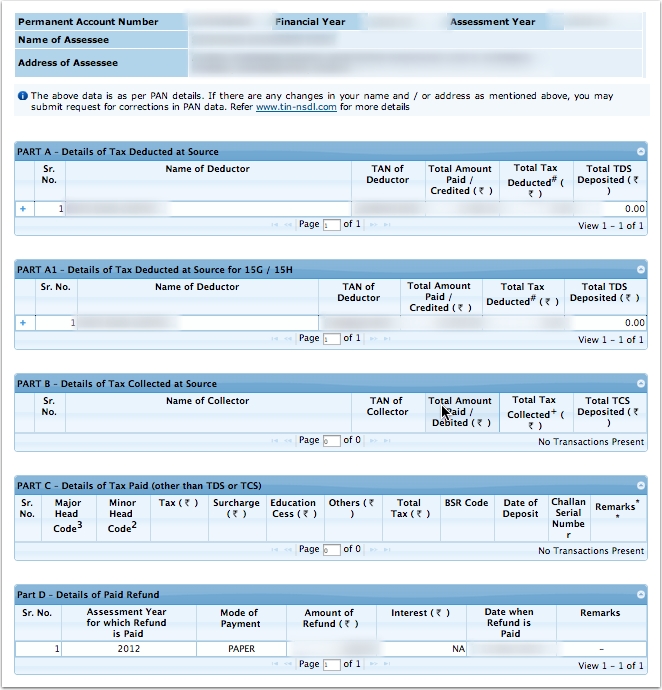
The Form 26AS contains:
  • Details of tax deducted on behalf of the taxpayer by deductors
  • Details of tax collected on behalf of the taxpayer by collectors
  • Advance tax/self assessment tax/regular assessment tax, etc. deposited by the taxpayers (PAN holders)
  • Details of paid refund received during the financial year
  • Details of the High value Transactions in respect of shares, mutual fund etc.
Entries in the Tax Credit Statement (Form 26AS) are generated when a valid PAN number has been reported in TDS statements.

Step 1.

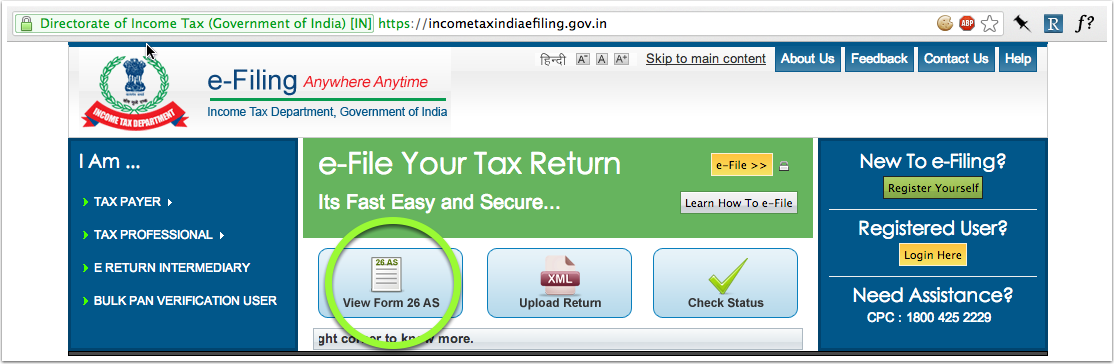
— Go to https://incometaxindiaefiling.gov.in and
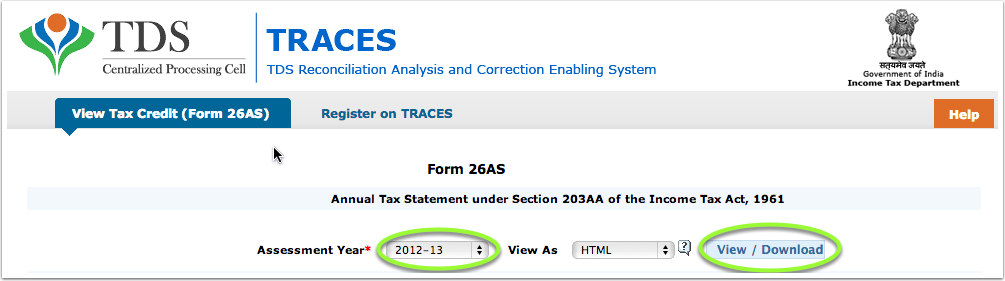
— Locate the Form 26-AS link on the page (circled in green), and click on it.

Step 2.

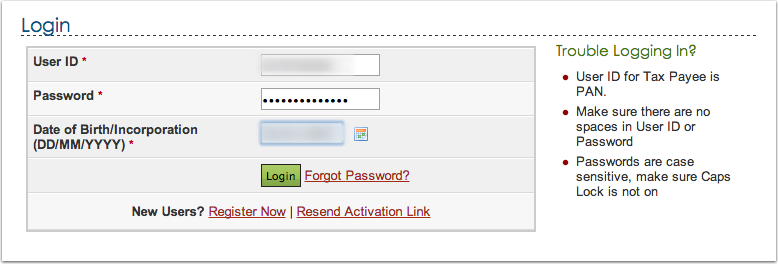
— Login using your account. If you don't have an account, you will have to register.
— You will have to enter your PAN number, password and date of birth / date of incorporation.

Step 3.

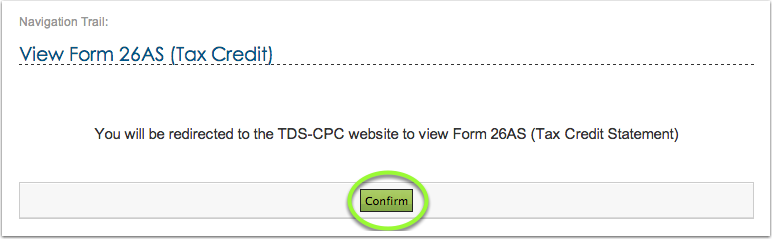
Confirm that you will be redirected to the TDS-CPC website.
(Don't worry, this is a necessary step and is completely safe since it is a government website)

Step 4.

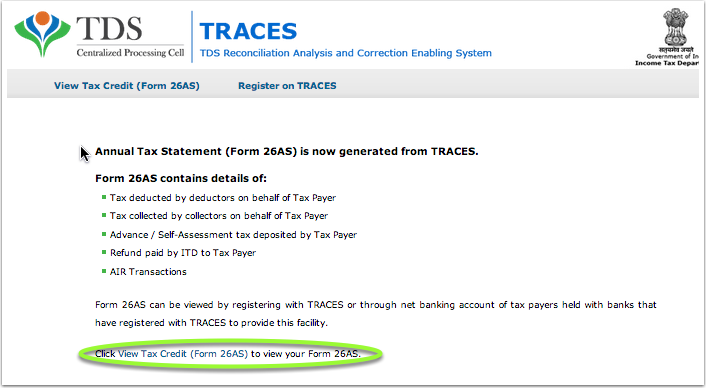
Click on the link at the bottom of the page.

Step 5.

— Choose the Assessment Year and the format in which you want to see the Form 26-AS.
— If you want to see it online, leave the format as HTML.
— If you would like to download a PDF for future reference, choose PDF.
— After you have made your choice, click on View/Download

Step 6.

 Your Form 26-AS will be shown!


Sale of 100% shareholding in subsidiary Co. could not be treated as 'Slump Sale'

Facts

a) The assessee-co. sold its entire shareholding in its subsidiary co. 'UHEL' to a third party.

b) Assessee worked out capital gains under section 48 on such transaction.

c) The Assessing Officer(‘AO’) opined that the said transaction would amount to slump sale of an undertaking and capital gains had to be computed under section 50B.

d) The Commissioner (Appeals) upheld the order of Assessing Officer.


e) Aggrieved-assessee filed the instant appeal before the Tribunal.

Held

1) As per section 2(42C),transfer of shares will not result into transfer of undertaking making it a slump sale for section 50B.

2) If impugned transaction would be regarded as slump sale, the consideration should have been received by UHEL, and not by the assessee because it was UHEL which had been transferred and being a distinct legal entity it was entitled for the sale consideration on its transfer. However, this was not the case since the sales consideration was received by assessee on transfer of shares of UHEL.

3) What the assessee had transferred was the shares in UHEL and this transfer of shares could not be considered as slump sale of an undertaking within the provisions of section 2(42C).[2016] 65 taxmann.com 161 (Mumbai - Trib.)

Friday, 22 January 2016

RECTIFICATION OF MISTAKE UNDER SECTION 154

Introduction 
Sometimes there may be a mistake in any order passed by the Assessing Officer. In such a situation, mistake which is apparent from the record can be rectified under section 154. The provisions relating to rectification of mistake under section 154 are discussed in this part.
 Order which can be rectified under section 154
With a view to rectifying any mistake apparent from the record, an income-tax authority may,
- a) Amend any order passed under any provisions of the Income-tax Act.
 b) Amend any intimation or deemed intimation sent under section 143(1).
 c) Amend any intimation sent under section 200A(1)(*) [section 200A deals with processing of statements of tax deducted at source i.e. TDS return].
 d) amend any intimation under section 206CB*.
 (*) Under section 200A, a TDS statement is processed after making correction of any arithmetical error in the statement or after correcting an incorrect claim, apparent from any information in the statement Similarly a new section 206CB is inserted by Finance Act, 2015 to provide for the processing of TCS statement.
 If due to rectification of mistake, the tax liability of the taxpayer is enhanced or refund is reduced, the taxpayer shall be given an opportunity of being heard.
Rectification of order which is subject to appeal or revision 
If an order is the subject-matter of any appeal or revision, any matter which is decided in such an appeal or revision cannot be rectified by the Assessing Officer. In other words, if an order is subject matter of any appeal, then the Assessing Officer can rectify only those matters which are not decided in such appeal.
Initiation of rectification by whom
The income-tax authority can rectify the mistake on its own motion. The taxpayer can intimate the mistake to the income-tax authority by making an application to rectify the mistake. If the order is passed by the Commissioner (Appeals), then the Commissioner (Appeals) can rectify mistake which has been brought to notice by the Assessing Officer or by the taxpayer.
Time-limit for rectification
No order of rectification can be passed after the expiry of 4 years from the end of the financial year in which order sought to be rectified was passed. The period of 4 years is from the date of order sought to be rectified and not 4 years from original order. Hence, if an order is revised, set aside, etc., then the period of 4 years will be counted from the date of such fresh order and not from the date of original order. In case an application for rectification is made by the taxpayer, the authority shall amend the order or refuse to allow the claim within 6 months from the end of the month in which the application is received by the authority.
The procedure to be followed for making an application of rectification 
Before making any rectification application the taxpayer should keep following points in mind.

  • The taxpayer should carefully study the order against which he wants to file the application for rectification. 
  •  Many times the taxpayer may feel that there is any mistake in the order passed by the Income-tax Department but actually the taxpayer’s calculations could be incorrect and the CPC might have corrected these mistakes, e.g., the taxpayer may have computed incorrect interest in return of income and in the intimation the interest might have been computed correctly. 
  •  Hence, to avoid application of rectification in above discussed cases the taxpayer should study the order and should confirm the existence of mistake in the intimation, if any. 
  •  If he observes any mistake in the order then only he should proceed for making an application for rectification under section 154. 
  •  Further, he should confirm that the mistake is one which is apparent from the records and it is not a mistake which requires debate, elaboration, investigation, etc. The taxpayer can file an online application for rectification of mistake. Before making an online application for rectification the taxpayer should refer to the rectification procedure prescribed at https://incometaxindiaefiling.gov.in/ 
  •  For rectification of intimation under Section 200A(1)/206CB online correction statement is to be filed; the procedure thereof is given at http://contents.tdscpc.gov.in/en/filing-correction-etutorial.html 
  •  An amendment or rectification which has the effect of enhancing the assessment or reducing a refund or otherwise increasing the liability of the taxpayer (or deductor) shall not be made unless the authority concerned has given notice to the taxpayer or the deductor of its intention to do so and allowed the taxpayer (or the deductor) a reasonable opportunity of being heard.  

Wednesday, 20 January 2016

Residential status of an Individual


To determine the residential status of an individual, the first step is to ascertain whether he is resident or non-resident. If he turns to be a resident, then the next step is to ascertain whether he is resident and ordinarily resident or is a resident but not ordinarily resident.
Step 1 given below will ascertain whether the individual is resident or non-resident and step 2 will ascertain whether he is ordinarily resident or not ordinarily resident. Step 2 is to be performed only if the individual turns to be a resident.
Step 1: Determining whether resident or non-resident
Under the Income-tax Law, an individual will be treated as a resident in India for a year if he satisfies any of the following conditions (i.e. may satisfy any one or may satisfy both the conditions):
(1) He is in India for a period of 182 days or more in that year; or
(2) He is in India for a period of 60 days or more in the year and for a period of 365 days or more in 4 years immediately preceding the relevant year.
If an individual does not satisfy any of the above conditions he will be treated as non-resident in India.
Note : Condition given in (2) above will not apply to an Indian citizen leaving India for the purpose of employment or to an Indian citizen leaving India as a member of crew of Indian ship or to an Indian citizen/person of Indian origin coming on a visit to India. A person is said to be of Indian origin, if he or any of his parents or grand-parents (maternal or paternal) were born in undivided India.
Note: With effect from Assessment Year 2015-16, in the case of an individual, being a citizen of India and a member of the crew of a foreign bound ship leaving India, the period or peri​ods of stay in India shall, in respect of such voyage, be determined in the manner and subject to such conditions as may be prescribed.
Step 2: Determining whether resident and ordinarily resident or resident but not ordinarily resident
A resident individual will be treated as resident and ordinarily resident in India during the year if he satisfies following conditions:
(1) He is resident in India for at least 2 years out of 10 years immediately preceding the relevant year.
(2) His stay in India is for 730 days or more during 7 years immediately preceding the relevant year.
A resident individual who does not satisfy any of the aforesaid conditions or satisfies only one of the aforesaid conditions will be treated as resident but not ordinarily resident.
In short, following test will determine the residential status of an individual:
  • If the individual satisfy any one or both the conditions specified at step 1 and satisfies both the conditions specified at step 2, then he will become resident and ordinarily resident in India.
  • If the individual satisfy any one or both the conditions specified at step 1 and satisfies none or one condition specified at step 2, then he will become resident but not ordinarily resident in India.
  • If the individual satisfy no conditions satisfied at step one, then he will become non-resident.